
Short answer: you can claim costs that are incurred wholly and exclusively for your business, such as premises, travel, software, insurance, marketing, professional fees and staff costs. Claiming them reduces your taxable profit, and so your tax bill. Costs that are private, or only partly for business, need to be excluded or apportioned. The figures below are for the 2026/27 tax year.
The test HMRC applies
An expense is deductible if it is incurred wholly and exclusively for the purposes of your trade. If a cost has a business part and a private part, you can usually claim only the business share. The rules are the same whether you are a sole trader or a limited company, but the tax saved differs.
What an expense is worth
A claim does not give you the cost back. It reduces your profit, so the saving depends on your tax rate.
| Structure | Rate that applies | Saving on a £1,000 expense |
|---|---|---|
| Sole trader, basic rate | 20% Income Tax + 6% Class 4 NI | £260 |
| Sole trader, higher rate | 40% Income Tax + 2% Class 4 NI | £420 |
| Limited company, profits up to £50,000 | 19% Corporation Tax | £190 |
| Limited company, profits over £250,000 | 25% Corporation Tax | £250 |
Spending money you do not need in order to save tax is never worthwhile. Claim what you genuinely spend, and make sure none of it is missed.
Common allowable expenses
Premises and running costs
- Rent, business rates, utilities, cleaning and repairs for business premises.
- Insurance, including professional indemnity and public liability.
Working from home
You can claim a proportion of household costs such as heating, electricity and broadband, based on your actual use. Sole traders can instead use flat rates for time worked from home each month: £10 for 25 to 50 hours, £18 for 51 to 100 hours and £26 for 101 hours or more. The flat rate is simple and needs no apportionment. Limited companies cannot use the flat rates, but can claim actual costs or pay the director a tax-free household expenses allowance.
Travel and vehicles
- Business journeys, including fares, parking and accommodation. Ordinary commuting between home and a permanent workplace is not allowable.
- If you use your own car, you can claim simplified mileage at 55p per mile for the first 10,000 business miles in the year and 25p per mile after that. The first rate rose from 45p on 6 April 2026. For example, 12,000 business miles gives £5,500 plus £500, a total of £6,000.
- Sole traders can claim actual vehicle costs instead, with the business proportion based on a mileage log.
Staff and subcontractors
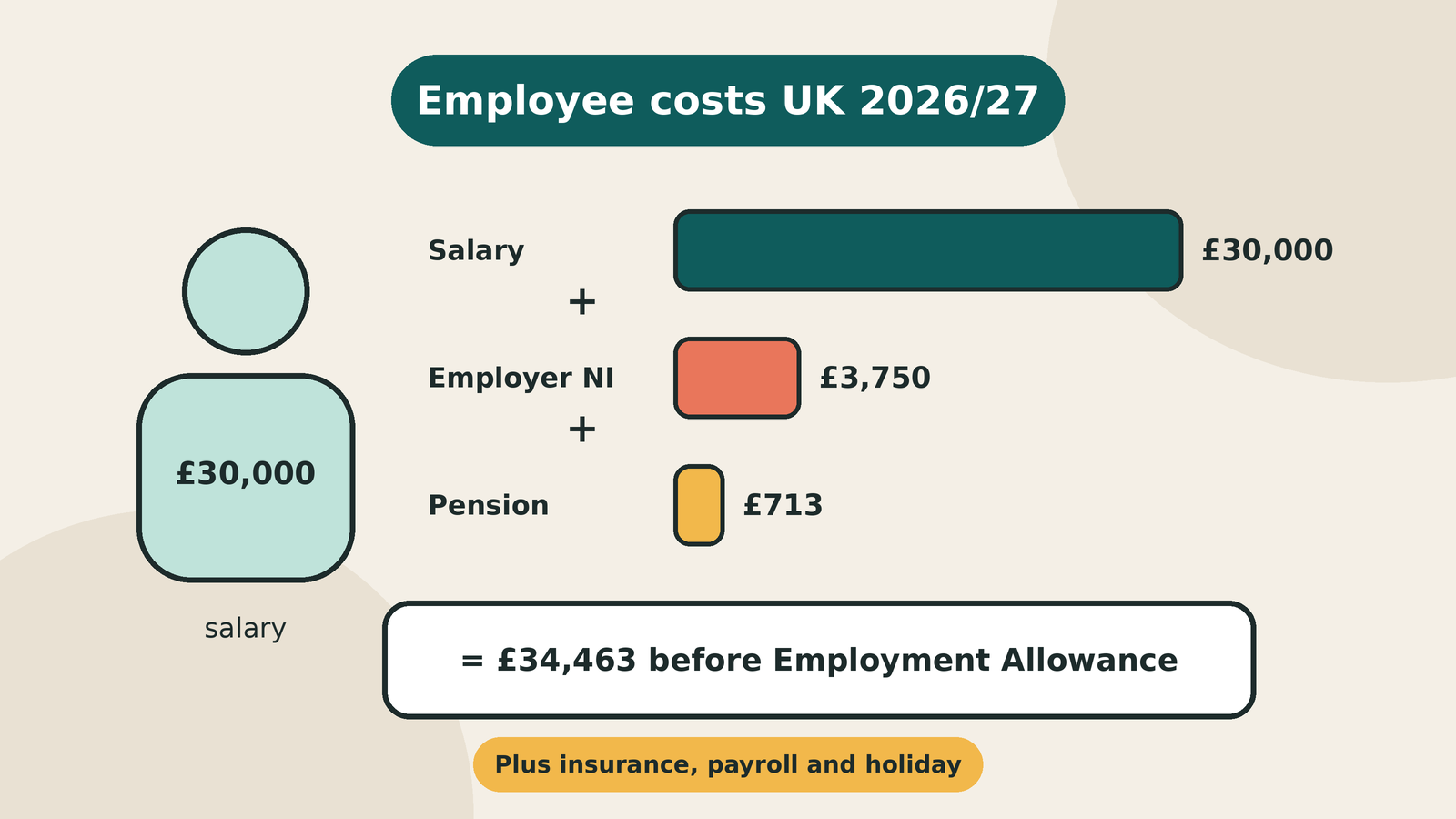
- Salaries, employer National Insurance, pension contributions and subcontractor costs.
- Staff party costs up to £150 per head per year, if open to all employees.
- Trivial benefits for employees up to £50 per item, subject to conditions.
Professional fees, marketing and software
- Accountancy, legal and other professional fees directly connected with the trade.
- Advertising, website costs, social media advertising and marketing.
- Software and subscriptions, bank charges and card processing fees.
Stock, materials and equipment
- Stock, raw materials and goods bought for resale.
- Equipment such as computers and machinery is usually claimed through capital allowances rather than as an expense. The Annual Investment Allowance lets most small businesses deduct up to £1,000,000 of qualifying purchases in a year.
Training and phones
- Training that maintains or updates skills you already use in the business. Training for a completely new trade is generally not allowable.
- Phone and internet costs, restricted to the business share where use is mixed. See can I put my phone through the business?
Restricted and non-allowable costs
- Client entertaining: not allowable, even if it helps win work. This includes meals and events for clients and suppliers.
- Everyday clothing: not allowable even if you only wear it for work. Protective clothing, uniforms with a logo and costumes are allowable.
- Fines and penalties: parking fines, speeding fines and HMRC penalties are not allowable.
- Personal spending: groceries, personal holidays and private subscriptions are not allowable. For a company, paying for these from the business account creates a director's loan.
- Depreciation: not allowable, which is why capital allowances exist.
- Commuting: travel between home and a permanent workplace.
Simplified expenses for sole traders
Sole traders can use flat rates for vehicles, home working and living at a business premises, instead of recording every actual cost. It reduces record keeping, but compare the result with your actual costs, because the flat rate is sometimes lower.
Keeping records
You need to keep records for at least 5 years after the 31 January submission deadline for the tax year, and 6 years for a company. Keep invoices and receipts, bank statements, mileage logs and a note of the business reason for any unusual cost. Digital bookkeeping software linked to your bank makes this far easier and prepares you for Making Tax Digital.
Frequently asked questions
Can I claim an expense if I forgot to keep the receipt?
The cost may still be allowable, but you need to be able to support it. Bank statements and supplier statements help, and a lost receipt is better than no evidence. Make a habit of capturing receipts as you buy.
Can I claim expenses before I start trading?
Costs incurred up to 7 years before you start trading can usually be claimed as if incurred on the first day of trading, if they relate to the business.
Can a limited company pay my personal bills?
Not without consequences. Personal spending from company money is treated as a director's loan, salary or dividend, and it may create a tax charge. See our guide on paying company income into a personal account.
Is a limited company better for claiming expenses?
The expenses rules are largely the same, so structure alone does not change what you can claim. A company has extra routes, such as pension contributions and a household expenses allowance. Our sole trader vs limited company calculator shows the overall effect.
Need help claiming everything you are entitled to?
We prepare accounts and tax returns for a fixed monthly fee and check that you claim every allowable cost. See our fixed price accountancy packages or get in touch.