
Hiring your first employee is a big step, and the salary on the contract is only part of what it costs. This guide sets out the real employee costs for a UK small business in 2026/27, with a worked example, so you can budget before you hire.
Short answer: an employee usually costs you more than their salary. On a £30,000 salary, the employer's National Insurance and the minimum pension contribution add roughly £4,460 a year before the Employment Allowance, which can wipe out the National Insurance cost for many small employers. Insurance, payroll, equipment, recruitment and training come on top.
The fixed costs of hiring an employee
Salary
You must pay at least the National Minimum Wage. From 1 April 2026 the National Living Wage for workers aged 21 and over is £12.71 an hour. The rates for younger workers and apprentices are lower: £10.85 for ages 18 to 20, and £8.00 for under 18s and apprentices. Check the government's guidance on how to calculate minimum wage before you set a salary, because some deductions and unpaid time can bring your pay below the minimum.
Employer National Insurance
For 2026/27 you pay employer National Insurance at 15% on an employee's earnings above the secondary threshold of £5,000 a year (£417 a month). On a £30,000 salary that is 15% of £25,000, or £3,750.
The Employment Allowance
Many small employers can claim the Employment Allowance, which reduces your employer National Insurance bill by up to £10,500 a year. For a business with one or two staff, this often means no employer National Insurance to pay at all. Eligibility rules apply. For example, it is not available to a company where the only person paid above the secondary threshold is also a director, so check before you rely on it.
Workplace pension
You must enrol eligible employees into a workplace pension. The legal minimum is 8% of qualifying earnings in total, and your share as the employer is at least 3%. Qualifying earnings are the slice between £6,240 and £50,270 a year. On a £30,000 salary, 3% of £23,760 is about £713 a year.
Employers' liability insurance
You need Employers' Liability insurance as soon as you employ someone, with at least £5 million of cover from an authorised insurer. You can be fined £2,500 for every day you are not properly insured. The main exemption is a business that employs only close family members, so most small employers do need it.
Payroll
Every employer must run PAYE through a payroll system that reports to HMRC in real time each time you pay someone. Payroll software or an accountant adds a cost, but doing it wrongly can lead to penalties. Duna payroll starts from £15 a month.
Equipment and workspace
Allow for a laptop, phone, software licences, tools or protective equipment, and desk space or home-working costs. The cost varies widely by role.
Variable costs and extras to budget for
- Recruitment. Job adverts can be cheap or free, but agencies usually charge a percentage of the first year's salary. Factor in your own time for interviews and right to work checks.
- Training and onboarding. A new starter is less productive at first, and some roles need courses or certification.
- Contract and policies. A written employment contract is a legal requirement, and handbooks and procedures help you stay compliant.
- Apprenticeship Levy. This is a 0.5% charge on your pay bill, but only for employers with an annual pay bill over £3 million, so most small businesses never pay it.
Employee entitlements
Holiday
Full-time employees on a five-day week are entitled to at least 28 days of paid leave a year, which is 5.6 weeks. You can count bank holidays as part of this. Holiday pay is part of the salary rather than an extra bill, but you are paying for it without getting the work. Over a year that is 5.6 weeks of paid time off against 46.4 weeks of work, so holiday adds about 12.07% to the cost of every hour actually worked. The same 12.07% is the figure often used to calculate holiday pay for workers with irregular hours or who work only part of the year. Build it into how much work you expect from each employee.
Statutory Sick Pay
Statutory Sick Pay for 2026/27 is £123.25 a week, or 80% of average weekly earnings if that is lower. You pay it for the days an eligible employee is off sick, so keep a small buffer in your budget.
Family leave pay
Statutory Maternity, Paternity, Adoption and Shared Parental Pay are paid at 90% of average weekly earnings for the first six weeks of Statutory Maternity or Adoption Pay, then at £194.32 a week or 90% of average earnings, whichever is lower. Most small employers can recover much of this from HMRC, but you pay it first, so cash flow matters.
Employee costs at a glance: a worked example
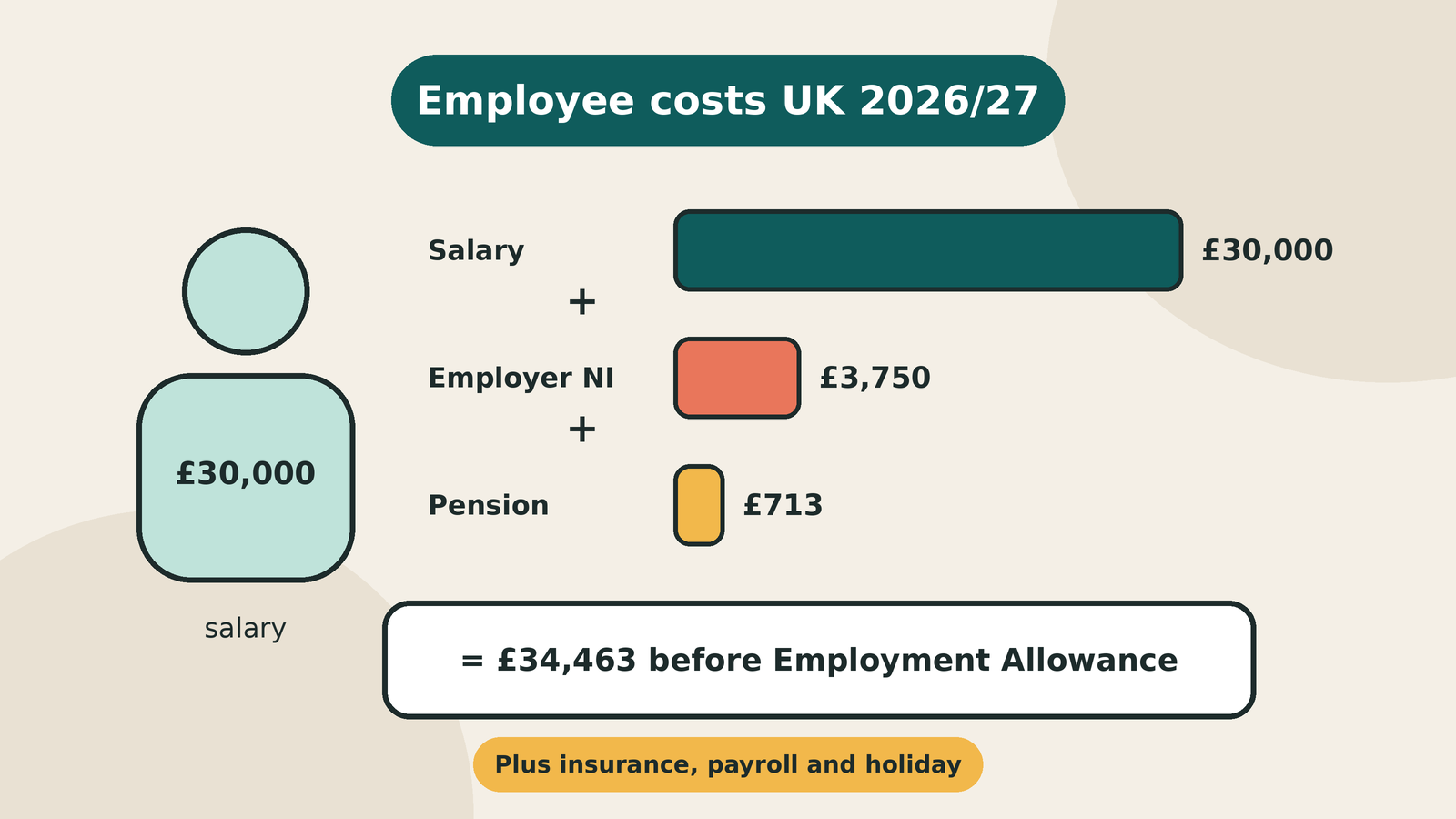
Here is the annual cost of an employee on a £30,000 salary in 2026/27:
| Cost | How it is worked out | Annual cost |
|---|---|---|
| Salary | Agreed salary | £30,000.00 |
| Employer National Insurance | 15% of (£30,000 minus £5,000) | £3,750.00 |
| Employer pension (minimum) | 3% of (£30,000 minus £6,240) | £712.80 |
| Total before Employment Allowance | £34,462.80 | |
| Employment Allowance (if eligible) | Up to £10,500 off employer National Insurance | minus £3,750.00 |
| Total after Employment Allowance | £30,712.80 |
This does not include insurance, payroll, equipment, recruitment, training or sick pay, so treat it as the minimum. A sensible rule of thumb is to budget for the salary plus National Insurance and pension, then add the extras that apply to your role.
Employee, contractor or partner?
Before you hire, check how the person will work with you. A genuine freelancer sends invoices and runs their own tax affairs, so you do not pay employer National Insurance or pension on them, but the working relationship has to be genuinely self-employed. If someone works under your control, at set hours, using your equipment, HMRC may treat them as an employee whatever the contract says. If you want to pay a spouse or partner, the pay has to be reasonable for the real work they do.
How to reduce the cost of hiring without cutting corners
- Check you are eligible for the Employment Allowance and claim it through payroll.
- Use an apprentice or part-time role where it genuinely fits the work.
- Run payroll properly from day one, so you avoid penalties and interest.
- Plan for sick pay and holiday cover so one absence does not hurt your cash flow.
- Keep clear records of what you pay and when, because it protects you if HMRC asks questions.
Frequently asked questions
What costs do I have to pay when I hire an employee?
At a minimum: salary, employer National Insurance above £5,000 a year, the employer's share of a workplace pension, and Employers' Liability insurance. You will also need payroll, and you may need equipment, training and recruitment.
How much is employer National Insurance in 2026/27?
15% on an employee's earnings above £5,000 a year. Many small employers can reduce their bill by up to £10,500 through the Employment Allowance.
What is the minimum pension contribution for an employee?
The total minimum is 8% of qualifying earnings, of which at least 3% comes from you as the employer. Qualifying earnings are between £6,240 and £50,270 a year.
What is the minimum wage I can pay?
From 1 April 2026, £12.71 an hour for workers aged 21 and over, £10.85 for ages 18 to 20, and £8.00 for under 18s and apprentices.
How much should I budget for holiday pay?
Full-time employees get at least 28 days a year (5.6 weeks), which can include bank holidays. It is part of their salary, but it adds about 12.07% to the cost of each hour actually worked.
Do I need a payroll system for one employee?
Yes. You must register as an employer, run PAYE, and report each payment to HMRC in real time.
Can I hire someone through my limited company?
Yes. The salary and employer costs are deductible for Corporation Tax if they are for the genuine needs of the business.
Need help with payroll and employee costs?
Duna Tax provides flat-fee, digital-first payroll, accounts and tax compliance for sole traders and small limited companies. See our fixed prices or get in touch and we will help you cost your first hire and set up payroll correctly.